


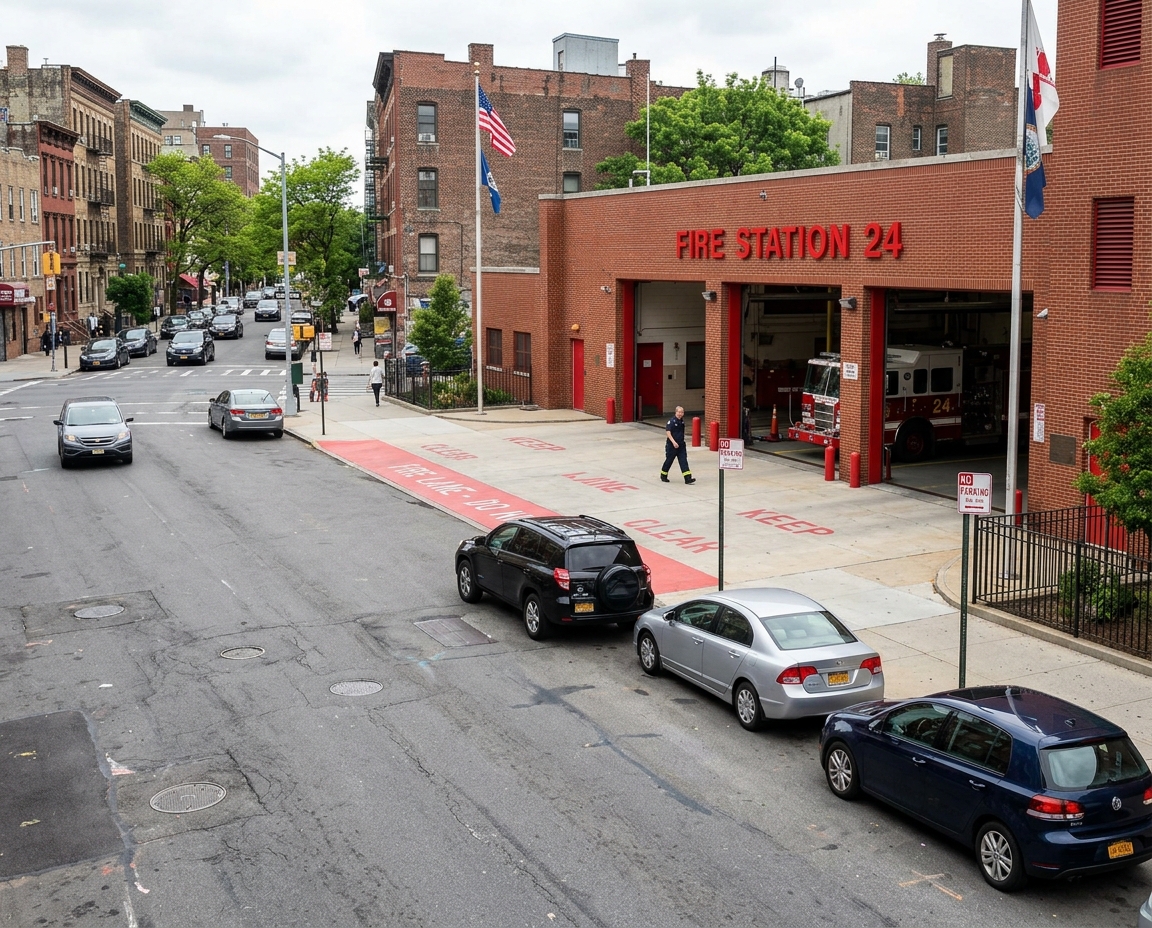
Parking, stopping, or leaving a vehicle in the wrong location can result in a California parking citation. One of the most commonly referenced laws concerning improper parking, standing, and stopping is California Vehicle Code § 22500.
California Vehicle Code § 22500 identifies several locations where a person generally may not stop, park, or leave a vehicle standing. These restrictions are intended to protect pedestrians, maintain traffic flow, preserve access to driveways and emergency facilities, and reduce roadway hazards.
Importantly, California Vehicle Code § 22500 is broader than a typical “no parking” rule. The statute applies to vehicles that are attended as well as unattended, meaning that staying inside the vehicle does not automatically make a stop lawful.
This guide explains what California Vehicle Code § 22500 means, where the law prohibits parking or stopping, what the 20-foot crosswalk rule means, how local parking rules can affect enforcement, and what drivers should know after receiving a citation.
What Is California Vehicle Code § 22500?
California Vehicle Code § 22500 prohibits a person from stopping, parking, or leaving a vehicle standing in certain specified locations.
The law begins with an important general rule: the restrictions apply whether the vehicle is attended or unattended. There are also exceptions when stopping is necessary to avoid a conflict with other traffic or when a driver is complying with the directions of a peace officer or an official traffic control device.
The statute then identifies specific locations where stopping, standing, or parking is prohibited.
These include:
- Within an intersection.
- On a crosswalk.
- In certain areas between a safety zone and the curb.
- Within 15 feet of a fire station driveway.
- In front of a public or private driveway.
- On a sidewalk.
- Alongside or opposite certain roadway excavations or obstructions when traffic would be blocked.
- Alongside another vehicle in a double-parking situation.
- In certain designated bus loading areas.
- In a tunnel or tube.
- On a bridge, subject to specific exceptions.
- In front of or upon certain wheelchair-accessible curb areas.
- In portions of a highway reserved exclusively for public transit buses.
- Within specified distances of certain crosswalks.
Because the statute covers many different situations, the particular subsection involved in a citation can be important.
What Does “Stop, Park, or Leave Standing” Mean?
Many drivers assume a parking law applies only when a vehicle is left unattended. That is not how CVC 22500 is written.
The statute expressly addresses a vehicle that is stopped, parked, or left standing, regardless of whether someone remains inside.
For example, imagine a driver pulls over in front of a private driveway and stays behind the wheel while waiting for a passenger. The driver might consider the vehicle “temporarily stopped,” but the location can still be prohibited under the applicable subsection of CVC 22500.
Similarly, turning on hazard lights does not automatically authorize a driver to stop in a prohibited location.
The circumstances matter, and statutory exceptions can apply. However, the fact that a driver intends to remain in the vehicle for only a few minutes does not by itself eliminate a parking restriction.
Where Does CVC 22500 Prohibit Parking or Stopping?
Parking Within an Intersection
Under subdivision (a), a vehicle generally may not be stopped, parked, or left standing within an intersection.
There is an exception for parking adjacent to curbs when permitted by local ordinance.
For example, a driver may pull into an intersection and stop while waiting for traffic to clear. If the vehicle is positioned within the intersection in a location prohibited by the statute and applicable local law, the driver may receive a citation.
Intersection parking can be particularly dangerous because it can interfere with turning vehicles and reduce visibility for pedestrians and other motorists.
Parking on a Crosswalk
Subdivision (b) generally prohibits stopping or parking on a crosswalk.
Crosswalk restrictions are designed to keep pedestrian crossing areas clear.
There is a limited exception involving certain buses and taxicabs stopping in an unmarked crosswalk to load or unload passengers when authorized by local ordinance.
Drivers should not assume that an empty crosswalk is available for temporary parking. A vehicle can obstruct a legally designated pedestrian crossing even when no pedestrian happens to be using it at that moment.
Parking in a Safety Zone
Subdivision (c) addresses the area between a safety zone and the adjacent right-hand curb, as well as certain areas identified by an authorized sign or red curb marking.
Safety zones can be used to protect pedestrians in locations where they may need to stand or move close to traffic.
The exact markings and local regulations can therefore be important when determining whether a particular location is restricted.
Parking Near a Fire Station Driveway
Under subdivision (d), a person generally may not stop, park, or leave a vehicle standing within 15 feet of the driveway entrance to a fire station.
The provision does not apply to a clearly marked vehicle owned or operated by a fire department.
The 15-foot restriction is intended to help preserve access for emergency vehicles.
For example, parking several feet from a fire station driveway because a nearby parking space is unavailable does not necessarily make the parking lawful. The statutory distance can apply regardless of whether the driver believes the vehicle is “out of the way.”
Blocking a Public or Private Driveway
Subdivision (e) generally prohibits stopping, standing, or parking in front of a public or private driveway.
This is one of the most familiar applications of CVC 22500.
For example, a driver parks directly across a residential driveway while picking up food from a nearby business. Even if the driver plans to return immediately, the vehicle may still be unlawfully positioned.
The law contains limited exceptions for certain buses, schoolbuses, and taxicabs when authorized by local authorities.
The statute also contains a specific rule for certain private road or driveway entrances in unincorporated areas where the entrance is not physically delineated by a traditional curb opening.
Parking on a Sidewalk
Subdivision (f) generally prohibits stopping, standing, or parking on a portion of a sidewalk or allowing the body of the vehicle to extend over part of a sidewalk.
For example, a driver may attempt to park partially on the roadway and partially on the sidewalk to make room for passing traffic. That positioning can violate CVC 22500.
The law contains limited exceptions, including one involving certain electric carts when authorized by local ordinance.
Required vehicle lights, mirrors, or other devices may also extend over a sidewalk within the limited distance specified by the statute.
Blocking Traffic Near an Excavation or Obstruction
Subdivision (g) addresses stopping, standing, or parking alongside or opposite a street or highway excavation or obstruction when doing so would obstruct traffic.
This provision can be relevant near construction projects, utility work, roadway repairs, and other temporary obstructions.
The important issue is not simply whether an excavation exists. The statute focuses on whether the vehicle’s position would obstruct traffic.
Double Parking
Subdivision (h) addresses what is commonly called double parking.
Generally, a person may not stop, park, or leave a vehicle standing on the roadway side of another vehicle that is already stopped, parked, or standing at the curb or edge of the highway.
For example, a driver stops next to a parked vehicle to pick up a passenger instead of using an available legal stopping area. Even if the driver remains in the driver’s seat, the situation can fall within the prohibition.
There is a specific exception for certain schoolbus situations described in the statute.
Parking in a Bus Loading Area
Subdivision (i) addresses certain curb spaces authorized for the loading and unloading of passengers of a bus engaged as a common carrier in local transportation.
Where the applicable curb space is properly indicated by a sign or red paint placed by local authorities pursuant to an ordinance, other vehicles generally may not stop, stand, or park there, subject to applicable exceptions.
This means drivers should pay attention to red curbs and posted bus-zone restrictions, particularly in urban areas.
Parking in a Tunnel or Tube
Subdivision (j) generally prohibits stopping, standing, or parking in a tube or tunnel.
An exception exists for vehicles belonging to authorities responsible for the repair, maintenance, or inspection of the facility when those vehicles are being used for those purposes.
The restriction is designed to prevent vehicles from creating dangerous obstructions in enclosed roadway areas.
Parking on a Bridge
Subdivision (k) generally prohibits stopping, standing, or parking upon a bridge.
However, this provision contains several exceptions. Certain maintenance and inspection vehicles are treated differently, and local authorities or the California Department of Transportation may permit parking on qualifying bridges under specified conditions.
Therefore, the rule should not be interpreted as meaning that parking is prohibited on every bridge under every circumstance. Authorized parking and properly posted locations can be treated differently.
Blocking a Wheelchair-Accessible Curb Area
Subdivision (l) prohibits stopping, standing, or parking in front of or upon a portion of a curb that has been cut down, lowered, or constructed to provide wheelchair accessibility to the sidewalk.
These curb areas are important because they provide access between the roadway and sidewalk for people using wheelchairs and other mobility devices.
A vehicle blocking such an access point can interfere with a person’s ability to safely enter or leave the sidewalk.
Parking in a Public Transit-Only Area
Subdivision (m) prohibits stopping, standing, or parking in a portion of a highway that has been designated for the exclusive use of public transit buses.
The restriction is intended to keep designated transit lanes available for buses and maintain reliable movement through areas where public transportation has been given exclusive roadway access.
What Is the California 20-Foot Crosswalk Parking Rule?
One of the most important modern developments involving CVC 22500 concerns parking near crosswalks.
Under subdivision (n), California generally prohibits stopping, standing, or parking:
- Within 20 feet of the vehicle approach side of a marked or unmarked crosswalk, or
- Within 15 feet of a crosswalk where a curb extension is present.
This provision became effective January 1, 2024.
The rule is intended to improve visibility around pedestrian crossings. A vehicle parked too close to a crosswalk can block a driver’s view of pedestrians and can also prevent pedestrians from seeing approaching vehicles.
What Is the “Approach Side” of a Crosswalk?
The approach side generally refers to the side from which vehicles travel toward the crosswalk.
The rule is therefore not simply a measurement of 20 feet from every part of a crosswalk in every direction. The statutory language specifically addresses the vehicle approach side.
Because the exact roadway configuration can matter, drivers should examine the physical layout of the intersection rather than relying solely on an estimated distance.
Is the 20-Foot Rule Always the Same?
Not necessarily.
California law allows a local authority to establish a different distance under certain circumstances. The local authority must establish the different distance by ordinance, including a finding that the distance is justified by established traffic safety standards, and must mark the different distance at the intersection using paint or a sign.
Local authorities can also authorize certain commercial vehicle loading and unloading within the otherwise restricted area when statutory requirements are satisfied.
Local authorities may additionally permit bicycle or motorized scooter parking within the specified crosswalk area under the circumstances described by the statute.
Can You Be Ticketed for the 20-Foot Rule Without a Painted Curb?
The answer depends on the circumstances and timing of enforcement.
When the crosswalk provision first took effect, California law included a temporary enforcement limitation. Before January 1, 2025, jurisdictions could generally issue only a warning rather than a citation for a violation unless the area was marked with paint or a sign.
That temporary provision expired on January 1, 2025.
As a result, drivers should not assume that a lack of a painted curb automatically means the 20-foot rule cannot be enforced today.
Does CVC 22500 Apply to Attended Vehicles?
Yes.
The opening language of Vehicle Code § 22500 expressly applies to vehicles whether they are attended or unattended.
This distinction is important.
Consider a driver who stops in front of a driveway with the engine running while waiting for someone. The driver may believe the vehicle is not “parked” because someone remains inside.
However, CVC 22500 does not limit its restrictions to unattended vehicles.
The specific circumstances and applicable exceptions still matter, but remaining inside the vehicle is not by itself a defense to an otherwise prohibited stop.
What Are the Penalties for a CVC 22500 Violation?
The amount associated with a parking citation can depend on the particular violation and the jurisdiction issuing the citation.
California does not have one single dollar amount that applies to every citation involving CVC 22500.
Different subdivisions can also involve different enforcement considerations, and local agencies may establish applicable parking penalties within the limits of state law.
For that reason, a driver should review the actual citation and the issuing agency’s instructions rather than relying on a general internet estimate of the cost.
Additional consequences can arise when parking citations remain unpaid.
Does a CVC 22500 Ticket Add Points to Your Driving Record?
A standard parking citation is generally treated differently from moving violations that result in negligent-operator points through the California DMV.
A typical CVC 22500 parking violation does not ordinarily function like a speeding or reckless-driving conviction for purposes of adding DMV points.
That does not mean the citation should be ignored.
Unpaid parking violations can create other consequences, including problems with vehicle registration renewal.
Can an Unpaid Parking Ticket Affect Vehicle Registration?
Yes.
California law allows unpaid parking violations to be placed on a vehicle registration record under certain circumstances.
When qualifying unpaid parking violations remain on record, the DMV can refuse to complete registration renewal unless the outstanding amounts are resolved through the applicable process.
This means a parking ticket can become more complicated if it is simply ignored.
A driver who believes a citation is incorrect should pay attention to the deadlines and procedures for contesting it rather than assuming that ignoring the citation will make it disappear.
Can a Vehicle Be Towed for a CVC 22500 Violation?
A vehicle can potentially be moved or removed in circumstances authorized by California law.
California Vehicle Code § 22654 provides authority for certain peace officers and employees enforcing parking laws to move a vehicle found standing on a highway in violation of specified provisions, including § 22500.
If moving the vehicle to an appropriate location is impracticable, the law can permit removal and storage under specified circumstances.
Whether a vehicle is actually towed depends on the facts, the location, applicable local regulations, and the authority being exercised.
Therefore, receiving a parking citation does not necessarily mean that every vehicle will automatically be towed. However, certain parking violations can create circumstances in which removal is legally authorized.
Can You Contest a CVC 22500 Parking Ticket?
If you believe a CVC 22500 citation was issued incorrectly, you may have a process available to contest it.
The appropriate procedure depends on the issuing agency and the type of citation.
Potential issues may include:
- The vehicle was not actually in the prohibited location.
- The wrong subsection was identified.
- The relevant distance was measured incorrectly.
- A required sign or marking was missing where one was legally required.
- A local ordinance changed the applicable rule.
- A statutory exception applied.
- The vehicle was stopped because of circumstances covered by an applicable exception.
- The citation contains inaccurate information.
- The location or roadway configuration does not match the alleged violation.
A person contesting a citation should review the instructions printed on the citation or provided by the issuing agency and comply with applicable deadlines.
What Evidence Can Help Challenge an Improper Parking Citation?
The useful evidence will depend on the specific allegation.
Photographs can be particularly helpful. For example, photographs may show:
- Where the vehicle was positioned.
- The location of the nearest crosswalk.
- Curb extensions.
- Street signs.
- Red curb markings.
- Driveway entrances.
- Sidewalk configuration.
- Bus-zone markings.
- Nearby roadway obstructions.
- Other conditions existing when the citation was issued.
Measurements can also be relevant when a citation concerns a distance requirement, such as the crosswalk restrictions.
If a driver has photographs, video footage, receipts, witness information, permits, or other documentation that accurately reflects the circumstances, those materials may be relevant to the applicable review process.
Common Examples of CVC 22500 Violations
Example 1: Blocking a Driveway
A driver parks directly across a residential driveway while visiting a nearby business.
Even if the driver plans to return within a few minutes, parking in front of the driveway can violate CVC 22500(e).
Example 2: Parking Partially on a Sidewalk
A driver places two wheels on the sidewalk because the roadway is crowded.
This can violate CVC 22500(f), which generally prohibits stopping or parking on a sidewalk or allowing the vehicle to extend over it.
Example 3: Double Parking to Pick Up a Passenger
A driver stops next to a vehicle already parked at the curb while waiting for a passenger.
This can fall under the double-parking restriction in CVC 22500(h), depending on the circumstances and applicable exception.
Example 4: Parking Too Close to a Crosswalk
A driver parks close to an intersection and believes the vehicle is far enough away because there is no painted curb.
The vehicle may nevertheless be within the statutory crosswalk distance under CVC 22500(n), subject to applicable local rules and statutory exceptions.
Example 5: Parking Near a Fire Station
A driver leaves a vehicle several feet from a fire station driveway while running into a nearby store.
CVC 22500(d) generally prohibits parking within 15 feet of the driveway entrance, subject to the statutory exception for qualifying marked fire department vehicles.
Frequently Asked Questions
What does CVC 22500 mean?
CVC 22500 is a California law regulating where vehicles may stop, stand, or park. It prohibits these activities in several specified locations, including certain intersections, crosswalks, driveways, sidewalks, bus areas, bridges, tunnels, and accessible curb areas.
Is CVC 22500 a parking violation?
CVC 22500 is commonly used for improper stopping, standing, and parking violations. The specific nature and consequences of a citation depend on the subsection involved and the applicable local enforcement rules.
Can I get a CVC 22500 ticket while sitting in my car?
Potentially, yes. The statute applies to attended as well as unattended vehicles. Remaining in the driver’s seat does not automatically make stopping in a prohibited location lawful.
Can I park in front of someone’s driveway in California?
Generally, no. CVC 22500(e) generally prohibits stopping, standing, or parking in front of a public or private driveway, subject to limited statutory and local exceptions.
How close can I park to a crosswalk in California?
The statewide rule generally prohibits stopping, standing, or parking within 20 feet of the vehicle approach side of a marked or unmarked crosswalk, or within 15 feet where a curb extension is present. Local authorities may establish a different distance if the statutory requirements are satisfied.
Can I park on a sidewalk if I leave room for pedestrians?
Generally, no. CVC 22500(f) generally prohibits stopping, standing, or parking on a portion of a sidewalk or allowing the vehicle to extend over a portion of the sidewalk, subject to limited exceptions.
Does a parking ticket affect my driver’s license points?
A standard parking citation generally does not operate like a moving violation that results in negligent-operator points. However, unpaid parking violations can create other consequences.
Can an unpaid CVC 22500 ticket prevent registration renewal?
Yes, qualifying unpaid parking violations can affect the ability to complete vehicle registration renewal until the outstanding violation is resolved through the applicable process.
Can my car be towed for improper parking?
Potentially. California law provides authority in certain circumstances to move or remove vehicles that are standing in violation of specified parking laws, including CVC 22500. Whether towing occurs depends on the particular circumstances and applicable law.
Does California’s 20-foot crosswalk rule apply to unmarked crosswalks?
Yes. The statutory rule refers to both marked and unmarked crosswalks, subject to the other provisions, exceptions, and local rules contained in the law.
What Should You Do After Receiving a CVC 22500 Citation?
If you receive a California parking citation alleging a violation of Vehicle Code § 22500, start by carefully reviewing the citation.
Identify:
- The specific Vehicle Code section or subsection listed.
- The date and location of the alleged violation.
- The instructions for paying or contesting the citation.
- The deadline for requesting an administrative review or other available process.
- Any information describing the location or circumstances of the alleged violation.
If you believe the citation is incorrect, gather relevant evidence promptly. Photographs of signs, curb markings, crosswalks, driveways, and the vehicle’s position can become difficult to obtain later if roadway conditions change.
Most importantly, do not assume that a citation can simply be ignored. Unresolved parking violations can result in additional fees or affect vehicle registration matters.
Understanding California Vehicle Code § 22500
California Vehicle Code § 22500 covers much more than traditional “no parking” situations. It regulates stopping, standing, and parking in locations where a vehicle could interfere with traffic, pedestrians, emergency access, public transportation, or accessibility.
The most important points to remember are:
- CVC 22500 applies to attended and unattended vehicles.
- Parking within an intersection can be prohibited.
- Parking on a crosswalk is generally prohibited.
- Parking in front of a public or private driveway is generally prohibited.
- Parking on a sidewalk is generally prohibited.
- Double parking is generally prohibited.
- Parking within 15 feet of a fire station driveway is generally prohibited.
- Certain bus zones, tunnels, bridges, transit-only areas, and accessible curb areas have specific restrictions.
- California’s crosswalk-distance rule generally prohibits parking within 20 feet of the approach side of a marked or unmarked crosswalk, with a 15-foot rule where a curb extension is present.
- Local authorities can modify certain crosswalk distances when statutory requirements are met.
- Unpaid parking citations can affect vehicle registration renewal.
- Certain circumstances can authorize the movement or removal of a vehicle.
Because parking restrictions can depend on the exact location, signs, markings, local ordinances, statutory exceptions, and facts surrounding the citation, a CVC 22500 violation should be evaluated based on the specific circumstances rather than assumptions about California parking laws generally.
Contact Southwest Legal
A parking citation can raise questions about the applicable law, the location of the vehicle, signage and markings, deadlines, and the options available for responding to the citation. Understanding those details can help you make a more informed decision about what to do next.
If you have questions about a California Vehicle Code § 22500 citation, Southwest Legal can help. Take the opportunity to discuss the circumstances surrounding your citation, better understand the issues that may matter, and learn what options may be available to you.
Don’t let an unfamiliar parking citation leave you guessing about your next step. Contact us today for a free consultation and get a clearer understanding of your situation.
Disclaimer: This article is for general informational purposes only and does not constitute legal advice or create an attorney-client relationship unless and until the firm and client enter into an agreement for legal services. Laws may change, and legal outcomes depend on the specific facts of each case. Consult a qualified attorney for advice regarding your situation.