


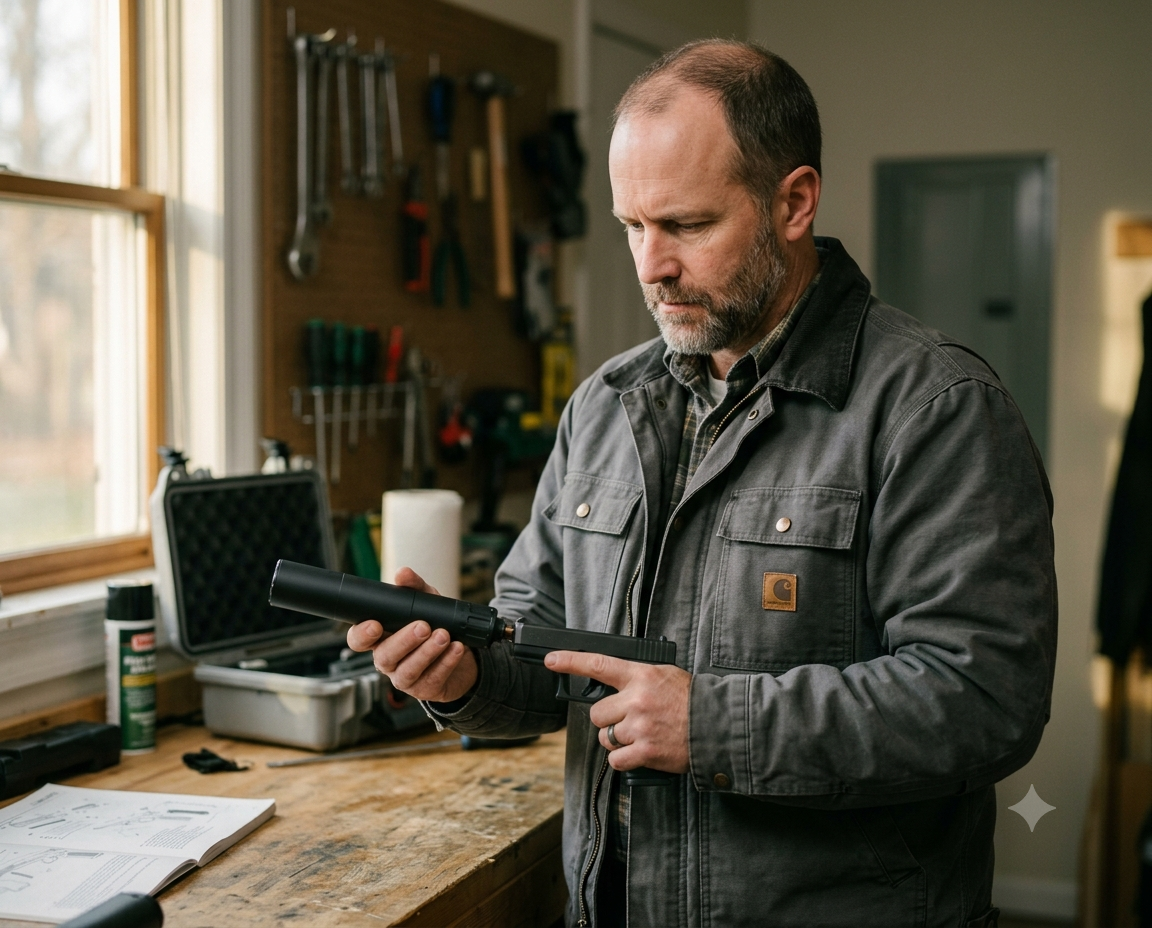
California has some of the strictest firearm laws in the United States, including regulations governing firearm accessories such as silencers, also known as suppressors. Under California Penal Code § 33410, it is generally illegal for a person to possess a silencer within the state. A conviction can result in felony charges, significant fines, and imprisonment.
This guide explains what California Penal Code § 33410 prohibits, the penalties for violating the law, potential legal defenses, exceptions that may apply, and answers to frequently asked questions.
What Is California Penal Code § 33410?
California Penal Code § 33410 makes it a criminal offense for a person to possess a silencer within California, unless a specific legal exception applies.
A silencer is a device designed to reduce the sound, muzzle flash, or report produced when a firearm is discharged. Although suppressors are legal under federal law in certain circumstances and are permitted in many states with federal approval, California law generally prohibits civilian possession altogether.
The law states that any person who possesses a silencer is guilty of a public offense punishable under California law.
What Is Considered a Silencer?
A silencer, often called a suppressor, is a device attached to the barrel of a firearm to reduce:
- Gunshot noise
- Muzzle blast
- Recoil (to some extent)
- Visible muzzle flash
Contrary to popular belief portrayed in movies, silencers do not make firearms completely silent. Instead, they reduce the intensity of the sound.
California law broadly interprets silencers to include devices designed or intended to suppress the report of a firearm.
Elements the Prosecutor Must Prove
To secure a conviction under California Penal Code § 33410, prosecutors generally must establish that:
- The defendant possessed a silencer.
- The object qualified as a silencer under California law.
- The defendant knowingly possessed the device.
Possession can be actual or constructive.
Actual Possession
Actual possession means the silencer was physically on the individual, such as:
- In a backpack
- In a pocket
- Attached to a firearm
- Being carried by hand
Constructive Possession
Constructive possession occurs when the person has control over the location where the silencer is found, even if it is not physically on them.
Examples include:
- Inside a vehicle
- In a safe
- Inside a home
- In a storage unit
- Inside a toolbox under the person’s control
Is Intent Required?
The prosecution does not necessarily need to prove the person intended to use the silencer unlawfully.
Instead, prosecutors generally only need to establish knowing possession.
For example:
- A person knowingly storing a suppressor in their garage may violate the law.
- A person transporting a suppressor in their vehicle may also violate the law.
Whether the device was ever attached to a firearm is often irrelevant.
Penalties Under California Penal Code § 33410
Possessing a silencer is generally prosecuted as a felony in California.
Potential penalties include:
- Felony conviction
- County jail or state prison sentence (depending on applicable sentencing laws)
- Significant fines
- Felony probation in qualifying cases
- Loss of firearm rights
- Criminal record
A felony conviction can also create long-term consequences affecting:
- Employment opportunities
- Professional licensing
- Housing applications
- Immigration status for non-citizens
- Security clearances
Can You Legally Own a Suppressor Registered with the Federal Government?
This is one of the most common questions people ask.
The answer is generally no for most civilians in California.
Under federal law, suppressors may be legally possessed after completing:
- A federal background check
- Registration with the Bureau of Alcohol, Tobacco, Firearms and Explosives (ATF)
- Payment of the federal tax stamp
- Compliance with federal regulations
However, California law is more restrictive than federal law.
Even if someone has federal approval, California law generally prohibits civilian possession unless a specific state exemption applies.
Federal approval does not automatically make possession legal in California.
Are There Any Exceptions?
California law contains limited exceptions.
Certain government agencies or authorized individuals may lawfully possess silencers under narrow circumstances.
Potential exceptions may include:
- Military personnel acting within official duties
- Certain law enforcement agencies
- Government-authorized testing
- Licensed manufacturers or dealers operating under applicable state and federal law
- Other specifically authorized entities provided by statute
These exceptions are limited and generally do not apply to ordinary firearm owners.
Common Legal Defenses
Every criminal case depends on its specific facts.
Possible legal defenses may include:
The Object Was Not Actually a Silencer
Sometimes prosecutors incorrectly classify a firearm accessory.
The defense may argue the object:
- Was incomplete
- Was non-functional
- Was not designed to suppress firearm noise
- Was a different type of firearm component
Expert testimony may be important in these cases.
Lack of Knowledge
The prosecution must generally prove knowing possession.
Examples include:
- Someone else placed the item in the defendant’s vehicle.
- The defendant borrowed a toolbox without knowing its contents.
- A roommate owned the device.
If the defendant had no knowledge of the silencer, this may create reasonable doubt.
Illegal Search and Seizure
Evidence obtained through an unlawful search may be challenged.
Examples include:
- Searches without a warrant where one was required
- Invalid consent
- Unconstitutional traffic stops
- Fourth Amendment violations
If a court suppresses the evidence, the prosecution’s case may become significantly weaker.
The Defendant Never Possessed the Device
Ownership is not always the issue.
The prosecution must prove possession or control.
A defense attorney may argue the defendant:
- Never exercised control
- Never handled the device
- Did not know where it was located
Examples of Violations
Example 1
A California resident purchases a suppressor in another state and brings it home.
Even if purchased legally elsewhere, possession in California may violate Penal Code § 33410.
Example 2
Police discover a suppressor inside a locked gun safe belonging to the homeowner.
Knowing possession may support criminal charges.
Example 3
A person unknowingly transports another individual’s firearm case containing a suppressor.
Whether criminal liability exists depends upon whether prosecutors can prove knowing possession.
Related California Firearm Laws
California has numerous firearm-related statutes that may arise alongside Penal Code § 33410, including laws involving:
- Assault weapons
- Short-barreled rifles
- Short-barreled shotguns
- Machine guns
- Large-capacity magazines
- Concealed firearms
- Prohibited persons possessing firearms
A person charged under Penal Code § 33410 may also face additional charges depending on the circumstances.
Frequently Asked Questions
Is it illegal to own a suppressor in California?
For most civilians, yes. California generally prohibits civilian possession of firearm suppressors, even though federal law allows possession in some states after registration.
Can I buy a suppressor in another state and bring it into California?
Generally no.
Possessing the suppressor in California may violate Penal Code § 33410 regardless of where it was purchased.
Does a federal tax stamp make suppressors legal in California?
No.
Federal approval does not override California’s prohibition.
Can I inherit a suppressor?
Inheritance does not necessarily make possession lawful under California law.
Anyone dealing with inherited firearms or firearm accessories should obtain legal advice before taking possession.
Is a homemade suppressor legal?
Generally no.
Homemade suppressors are also prohibited under California law and may additionally violate federal law if manufactured without complying with applicable federal requirements.
Is merely possessing a suppressor enough to be charged?
Yes.
California law generally criminalizes possession itself.
The prosecution usually does not need to prove the suppressor was used in a crime.
What if the suppressor does not work?
Depending on the facts, prosecutors may still argue the device qualifies as a silencer if it was designed or intended to suppress firearm noise.
The functionality of the device may become an issue requiring expert testimony.
Can police search my vehicle because they suspect I have a suppressor?
Police searches must comply with constitutional protections.
Whether a search is lawful depends on the circumstances, including warrants, probable cause, consent, or recognized exceptions to the warrant requirement.
Consequences Beyond Criminal Penalties
A conviction under California Penal Code § 33410 may affect more than incarceration.
Additional consequences may include:
- Permanent criminal record
- Difficulty obtaining employment
- Loss of firearm ownership rights
- Immigration consequences
- Professional licensing issues
- Increased penalties for future criminal cases
Because these collateral consequences can be substantial, individuals facing charges should understand both the immediate and long-term implications.
What Should You Do If You Are Charged?
Anyone charged with violating California Penal Code § 33410 should avoid making statements about the case without legal counsel. Criminal cases often involve complex factual and constitutional issues, including whether the object legally qualifies as a silencer, whether possession can be proven, and whether law enforcement conducted a lawful search.
The strength of the prosecution’s case depends on the evidence, witness testimony, forensic examination of the device, and compliance with constitutional procedures.
Key Takeaways
California Penal Code § 33410 makes possession of a firearm silencer generally illegal within the state. Unlike federal law, which permits suppressor ownership under specific registration requirements in many jurisdictions, California broadly prohibits civilian possession regardless of federal registration. Prosecutors typically must prove knowing possession of a device that legally qualifies as a silencer, while defenses may involve lack of knowledge, unlawful searches, or disputes over whether the item meets the legal definition. Because a conviction can carry serious criminal and collateral consequences—including imprisonment, loss of firearm rights, and impacts on employment and immigration—it is important for anyone facing allegations under this statute to understand the law and seek qualified legal advice tailored to their circumstances.
Why Choose Southwest Legal?
If you or someone you care about has been charged with violating California Penal Code § 33410 or any other firearm-related offense, obtaining experienced legal representation as early as possible can make a significant difference. Criminal firearm cases often involve complex legal issues, including constitutional protections, evidentiary challenges, and the interpretation of California’s firearm laws.
At Southwest Legal, our criminal defense team is committed to protecting our clients’ rights and providing strategic legal representation tailored to the facts of each case. We carefully review every aspect of the prosecution’s evidence, evaluate potential defenses, and work toward the best possible outcome.
If you are facing firearm charges in Southern California or have questions about your legal rights, don’t wait to seek legal guidance. Early intervention can be critical in protecting your future.
Contact us today for a free consultation with an experienced California criminal defense attorney. We are ready to review your case, explain your legal options, and help you navigate every step of the criminal justice process.
Disclaimer: This article is for general informational purposes only and does not constitute legal advice or create an attorney-client relationship. No attorney-client relationship is formed unless and until the firm and client enter into an agreement for legal services. Laws may change, and legal outcomes depend on the specific facts of each case. Consult a qualified attorney for advice regarding your situation.