


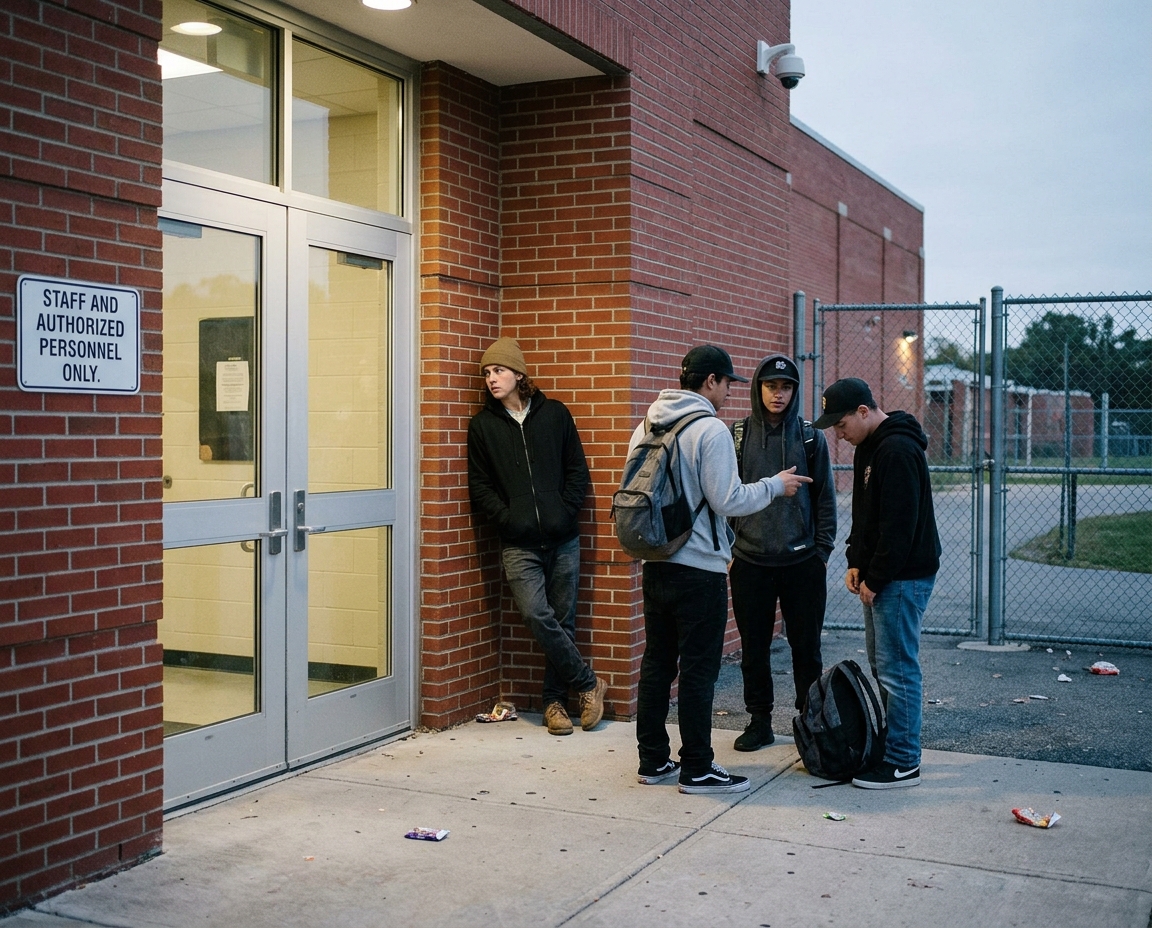
California Penal Code § 653(b) addresses certain types of loitering at or near schools and public places where children attend or normally congregate. The law is designed to address potentially criminal conduct around locations where children are present, but it does not mean that simply being near a school is automatically a crime.
One of the most important aspects of a California Penal Code § 653(b) case is criminal intent. California courts have interpreted the statute to require proof that a person was lingering or remaining in the prohibited setting with the intent to commit a crime if the opportunity arose.
That distinction matters. A parent waiting to pick up a child, a visitor attending a school event, or a person walking through a public area near a school is not necessarily committing a crime merely because they are present.
This article explains what California Penal Code § 653(b) prohibits, what prosecutors generally must prove, how the 72-hour provision works, potential penalties, common defenses, and frequently asked questions about school-loitering charges.
What Is California Penal Code § 653(b)?
California Penal Code § 653(b) is commonly referred to as California’s loitering at a school law.
The statute applies to a person who loiters around a school or a public place at or near which children attend or normally congregate and who remains there under circumstances covered by the statute. It also addresses returning to or coming upon a school or covered public place within 72 hours after being asked to leave by certain authorized individuals.
The statute defines “loiter” as delaying, lingering, or idling around a school or public place without lawful business for being present.
However, California courts have interpreted the statute to include an additional requirement: the prosecution must establish that the person intended to commit a crime.
This interpretation is important because it prevents the statute from turning ordinary, innocent presence near a school into a criminal offense.
Is It Illegal to Loiter Near a School in California?
Not necessarily.
Simply being near a school does not automatically violate Penal Code § 653(b).
Under the current California criminal jury instruction addressing this offense, the prosecution generally must establish that the defendant:
- Delayed, lingered, or idled at or near a school or covered public place, or engaged in the conduct involving remaining or returning after being asked to leave;
- Did not have a lawful purpose for being at or near the location; and
- Intended to commit a crime if the opportunity arose.
The third requirement is particularly significant.
In In re Gary H., a California Court of Appeal decision, the court upheld the constitutionality of Penal Code § 653(b) because the statute, as interpreted by the court, requires proof of criminal intent.
The case involved a teenager who remained near a school after being told to leave. The evidence supported the juvenile court’s finding that he intended to engage in a fight. The appellate court concluded that the evidence was sufficient under the statute as construed.
The decision therefore illustrates an important principle: the government must establish more than mere presence near a school.
What Does “Loiter” Mean Under Penal Code § 653(b)?
Penal Code § 653(b) provides its own definition of “loiter.”
In general terms, the statute describes loitering as:
- Delaying;
- Lingering; or
- Idling
around a school or public place without lawful business for being there.
This means the legal concept of loitering is not necessarily the same as simply standing somewhere for an extended period.
For example, someone who waits outside a school because they are picking up their child has a different purpose from someone who remains near the school while intending to commit a crime.
The circumstances surrounding the person’s presence therefore matter.
What Must the Prosecution Prove in a Penal Code § 653(b) Case?
The prosecution has the burden of proving the required elements of a criminal offense beyond a reasonable doubt.
California’s current criminal jury instruction for Penal Code § 653(b), CALCRIM No. 2917, identifies the following important requirements.
1. The Defendant Delayed, Lingered, or Idled Near a Covered Location
The prosecution must establish conduct that falls within the statute.
The location can include a school attended by children or a public place where children normally congregate.
Simply passing by a school or briefly stopping in the area does not automatically establish this element.
2. The Defendant Did Not Have a Lawful Purpose
The prosecution must establish that the person did not have a lawful purpose for being at or near the school or covered public place.
A legitimate reason for being present can be important evidence in a case.
Examples may include:
- Picking up or dropping off a child;
- Attending a school event;
- Meeting with school personnel;
- Conducting authorized business;
- Working at the school;
- Providing a legitimate service;
- Waiting for transportation for a lawful reason; or
- Participating in an authorized activity.
Whether a particular activity qualifies as a lawful purpose depends on the circumstances.
3. The Defendant Intended to Commit a Crime
This is one of the most important requirements.
California appellate authority has interpreted Penal Code § 653(b) to require proof that the person intended to commit a crime.
The current CALCRIM instruction describes this requirement as the defendant having intended to commit a crime if the opportunity arose.
This means prosecutors generally cannot establish the offense merely by showing that someone was present near a school and appeared suspicious.
There must be evidence supporting the required criminal intent.
Why Is Criminal Intent Important?
Criminal intent is important because Penal Code § 653(b) could otherwise potentially reach innocent conduct.
People routinely spend time around schools for legitimate reasons.
For example, a person might:
- Wait for a child;
- Attend a parent-teacher conference;
- Watch a school sporting event;
- Walk along a public sidewalk;
- Wait for a ride;
- Meet someone for a legitimate purpose; or
- Conduct authorized business.
The California Court of Appeal addressed the constitutional issue in In re Gary H.
The court concluded that Penal Code § 653(b), as interpreted to require an intent to commit a crime, provided sufficient limits to avoid being unconstitutionally vague.
In other words, the criminal-intent requirement helps distinguish potentially criminal conduct from innocent activity around schools.
What Is the 72-Hour Rule Under Penal Code § 653(b)?
Penal Code § 653(b) also contains a provision concerning a person who returns to or comes upon a covered school or public place within 72 hours after being asked to leave by certain authorized individuals.
Those individuals can include certain school administrators or authorized school security personnel, as well as specified law enforcement officers.
For example, imagine that a person is at a school and is properly instructed to leave by an individual authorized under the statute. If the person returns to the covered location the next day, the return may become relevant under the statute’s 72-hour provision.
However, the existence of a request to leave does not mean that every situation automatically results in a conviction.
The precise language of the statute, the circumstances of the request, the person’s conduct, the person’s purpose, and the evidence concerning criminal intent can all matter.
Does a Person Have to Be Asked to Leave Before Penal Code § 653(b) Applies?
This question requires some care.
The language of Penal Code § 653(b) addresses both loitering and conduct involving remaining, reentering, or coming upon a school or covered public place after being asked to leave.
California’s current CALCRIM No. 2917 recognizes an ambiguity concerning how these provisions interact. The instruction explains that courts must determine how the statutory provisions apply when a defendant is charged with the conduct described in the request-to-leave portion.
Accordingly, it would be inaccurate to make a blanket statement that every Penal Code § 653(b) case requires a prior request to leave.
It would also be inaccurate to suggest that a request to leave automatically establishes every element of the offense.
The particular charge and facts matter.
Who Can Ask Someone to Leave Under Penal Code § 653(b)?
The statute identifies certain people who may issue a request to leave that is relevant to its 72-hour provision.
Depending on the circumstances, these can include:
- The school’s chief administrative official;
- A person acting as the chief administrative official;
- An authorized member of a school district security patrol;
- A city police officer;
- A sheriff or deputy sheriff; or
- A California Highway Patrol peace officer.
The statute contains specific requirements concerning school security personnel and their authorization.
Because the statutory language is specific, questions about who issued the order, that person’s authority, what was communicated, and what happened afterward can become important in a criminal case.
What Are the Penalties for Penal Code § 653(b)?
For the ordinary offense under Penal Code § 653(b), the statute provides for:
- A fine of up to $1,000;
- Imprisonment in county jail for up to six months; or
- Both a fine and imprisonment.
The offense is generally treated as a misdemeanor.
The statute also establishes different penalty provisions for certain individuals who are subject to particular registration requirements.
Penalties for Certain Registered Sex Offenders
Penal Code § 653(b) provides enhanced penalties for a person who is required to register as a sex offender and violates the applicable provision.
For a first conviction, the statute permits:
- A fine of up to $2,000;
- County jail for up to six months; or
- Both.
The statute provides additional consequences for qualifying repeat convictions, including specified minimum jail terms.
Penalties for Certain Penal Code § 186.30 Registrants
The statute also contains separate penalty provisions for individuals required to register under Penal Code § 186.30.
Depending on the person’s conviction history, the statute allows for:
- Fines of up to $1,000 or $2,000; and
- County jail terms of up to one year.
Additional considerations apply to repeat convictions.
Because these enhanced provisions can substantially affect potential punishment, a person’s legal status and criminal history can be important when evaluating an actual case.
Examples of Penal Code § 653(b) Situations
The following hypothetical examples are intended to illustrate the difference between lawful presence and potentially criminal conduct.
Example 1: Parent Waiting for a Child
A parent arrives near an elementary school to pick up a child. Traffic is backed up, so the parent waits nearby for 20 minutes.
The mere fact that the parent is waiting near a school does not establish a Penal Code § 653(b) violation.
The parent has an apparent lawful reason for being there, and nothing about the hypothetical establishes an intent to commit a crime.
Example 2: Attending a School Event
An adult attends a public school sporting event and remains in the area afterward while waiting for friends.
Again, the person’s presence alone would not establish the required elements of Penal Code § 653(b).
The person’s purpose and actual conduct would be relevant.
Example 3: Remaining Near a School With Criminal Intent
Suppose a person repeatedly remains near a school without a legitimate reason and evidence shows that the person is waiting for an opportunity to commit a crime.
That situation is substantially different.
Evidence of statements, conduct, preparation, interactions with others, or other surrounding circumstances could potentially be used to establish criminal intent.
Whether the evidence is legally sufficient would depend on the particular case.
Example 4: Returning After Being Asked to Leave
A person is properly asked to leave a school by an authorized individual. The person returns to the covered location the following day.
The return may implicate the 72-hour provision of Penal Code § 653(b).
However, whether the person can ultimately be convicted depends on the applicable statutory requirements and the evidence.
Can You Be Charged With Loitering Simply for Being Near Children?
Simply being near children does not automatically violate Penal Code § 653(b).
The statute applies to specified locations and conduct, and California appellate authority requires proof of criminal intent.
This distinction is important because schools are surrounded by public roads, sidewalks, businesses, parks, homes, and other places where people may have entirely legitimate reasons to be present.
The law does not establish a general rule that a person commits a crime merely because children are nearby.
Is Penal Code § 653(b) Unconstitutionally Vague?
A California Court of Appeal addressed this issue in In re Gary H.
The defendant argued that Penal Code § 653(b) was unconstitutionally vague.
The appellate court rejected that challenge.
The court explained that interpreting the statute to require proof of an intent to commit a crime provided an important limitation on the law and helped establish a meaningful standard for enforcement.
The decision remains important when understanding why criminal intent is such a significant part of a Penal Code § 653(b) case.
Does the First Amendment Apply to School-Loitering Cases?
Constitutional rights can be relevant depending on what the person was doing.
California case law has addressed situations involving expressive activity near schools. In one earlier case, the court considered a defendant who was distributing leaflets protesting the Vietnam War and encouraging a student strike.
The court concluded that the defendant could not be convicted under the applicable school-loitering law based solely on that protected activity.
This history demonstrates that a Penal Code § 653(b) case cannot necessarily be evaluated without considering constitutional protections.
However, First Amendment protection does not automatically prevent enforcement of otherwise valid laws. The particular conduct, purpose, and circumstances remain important.
What Are Possible Defenses to a Penal Code § 653(b) Charge?
There is no single defense that applies to every school-loitering case. Potential legal and factual issues can include the following.
Lawful Purpose
Evidence may show that the person had a legitimate reason for being at or near the school.
For example, the person may have been picking up a child, attending an event, meeting with school personnel, working, or conducting legitimate business.
Lack of Criminal Intent
Because California courts have interpreted § 653(b) to require intent to commit a crime, evidence that the defendant lacked that intent may be important.
Insufficient Evidence
The prosecution must prove the required elements beyond a reasonable doubt.
If the evidence does not establish one or more required elements, that can become a significant issue in the case.
Mistaken Identity
In some cases, a defendant may dispute whether they were the person who engaged in the alleged conduct.
Issues Concerning a Request to Leave
Where the prosecution relies on the request-to-leave provisions, questions can arise regarding:
- Who issued the request;
- Whether that person was authorized;
- What exactly the person was told;
- Whether the defendant understood the instruction;
- Whether the person remained or returned; and
- When the alleged return occurred.
Constitutional Issues
Depending on the circumstances, constitutional issues involving protected speech, vagueness, or other legal rights may arise.
These are potential legal issues rather than guarantees of a particular result.
How Is Penal Code § 653(b) Different From Trespassing?
Penal Code § 653(b) and California trespass laws address different conduct.
Trespassing generally involves entering or remaining on property under circumstances prohibited by a particular trespass statute.
Penal Code § 653(b) focuses on loitering at or near schools and certain public places where children normally congregate, with the additional criminal-intent requirement recognized by California courts.
The same incident can sometimes involve more than one potential criminal statute, depending on what occurred.
For example, an allegation involving someone who enters restricted school property and then engages in other conduct could raise separate legal questions concerning trespass, school-safety laws, or Penal Code § 653(b).
Can a Person Be Convicted if They Had a Lawful Reason to Be There?
A lawful purpose can be highly significant because Penal Code § 653(b) specifically addresses whether the person had lawful business for being present.
Consider a parent who waits near a school because their child’s bus is delayed.
That person’s presence is very different from someone who has no legitimate reason to be there and is allegedly waiting for an opportunity to commit a crime.
The specific facts determine how the statute applies.
What Happens After a Penal Code § 653(b) Arrest or Charge?
A criminal case can involve several stages, depending on the circumstances.
These may include:
- An investigation or contact with law enforcement.
- A citation or arrest.
- An arraignment.
- Pretrial hearings.
- Discovery and review of evidence.
- Motions or negotiations.
- A possible resolution before trial.
- A trial if the case is not otherwise resolved.
The exact process varies depending on the facts and procedural posture of the case.
Evidence potentially relevant to a school-loitering allegation can include police reports, witness statements, surveillance video, school records, communications, photographs, and other evidence.
Frequently Asked Questions
Is loitering at a school a misdemeanor in California?
The ordinary violation of Penal Code § 653(b) is a misdemeanor carrying a statutory maximum of six months in county jail and a fine of up to $1,000. The statute contains separate penalty provisions for certain individuals subject to specified registration requirements.
Can someone be arrested just for standing outside a school?
Standing outside a school is not, by itself, enough to establish every element of Penal Code § 653(b). The circumstances, lawful purpose, conduct, and evidence of criminal intent matter.
Do you have to be on school property to violate Penal Code § 653(b)?
Not necessarily. The statute applies to loitering about a school or a public place at or near which children attend or normally congregate. Therefore, the law is not limited solely to conduct physically inside school buildings or on school grounds.
What does “without lawful business” mean?
The phrase generally refers to being present without a legitimate or lawful reason for being there. The circumstances determine whether a person’s purpose was lawful.
What is the 72-hour rule?
The statute addresses a person who reenters or comes upon a covered school or public place within 72 hours after being asked to leave by an individual identified in the statute.
Does a police officer have to ask someone to leave?
Not necessarily in every Penal Code § 653(b) prosecution. The statutory language contains different provisions concerning loitering and remaining or returning after a request to leave, and California’s jury instructions recognize an ambiguity concerning how those provisions interact.
Is criminal intent required?
Yes. California appellate authority has construed Penal Code § 653(b) to require proof that the person intended to commit a crime. The current California criminal jury instruction for the offense expressly includes this intent requirement.
Can a parent be accused of loitering while waiting for a child?
A parent waiting for a child has an obvious example of a potentially lawful purpose. However, every case depends on its specific circumstances and evidence.
Can protected speech be relevant to a Penal Code § 653(b) case?
Yes. California case law recognizes that protected expressive activity can raise constitutional issues in the application of school-loitering laws. The particular facts and nature of the activity matter.
Is Penal Code § 653(b) the same as general loitering?
No. Penal Code § 653(b) is a specific California statute addressing loitering at or near schools and certain public places where children normally congregate. It should not automatically be treated as interchangeable with other California laws involving loitering or trespassing.
Key Takeaways
California Penal Code § 653(b) is more nuanced than the phrase “loitering at a school” might suggest.
The key points are:
- The statute addresses loitering around schools and certain public places where children attend or normally congregate.
- “Loiter” includes delaying, lingering, or idling without lawful business for being present.
- California appellate authority has interpreted the statute to require proof of an intent to commit a crime.
- Simply being near a school or children does not automatically constitute a violation.
- A lawful reason for being present can be an important issue.
- The statute contains a 72-hour provision concerning returning to or coming upon a covered location after being asked to leave by certain authorized individuals.
- The ordinary offense carries a maximum fine of $1,000 and up to six months in county jail.
- Separate penalty provisions apply to certain individuals subject to specified registration requirements.
- Constitutional issues, including First Amendment considerations, can arise depending on the facts.
- The prosecution must prove the required elements beyond a reasonable doubt.
Contact Southwest Legal
Facing a California Penal Code § 653(b) Charge?
A California school-loitering allegation can involve much more than the simple question of whether someone was near a school. The person’s purpose, conduct, intent, location, interactions with school officials or law enforcement, and the available evidence may all matter.
If you or someone you care about is facing an allegation under California Penal Code § 653(b), getting accurate information early can make the legal process easier to understand. Southwest Legal is here to help you understand what comes next.
Contact us today for a free consultation and take the first step toward understanding your legal situation. A conversation with a qualified California criminal defense professional can help you learn more about the allegations, the legal issues that may apply, and the options available based on the circumstances of your case.
Don’t navigate a criminal charge without understanding your rights.
Disclaimer: This article is for general informational purposes only and does not constitute legal advice or create an attorney-client relationship. No attorney-client relationship is formed unless and until the firm and client enter into an agreement for legal services. Laws may change, and legal outcomes depend on the specific facts of each case. Consult a qualified attorney for advice regarding your situation.