


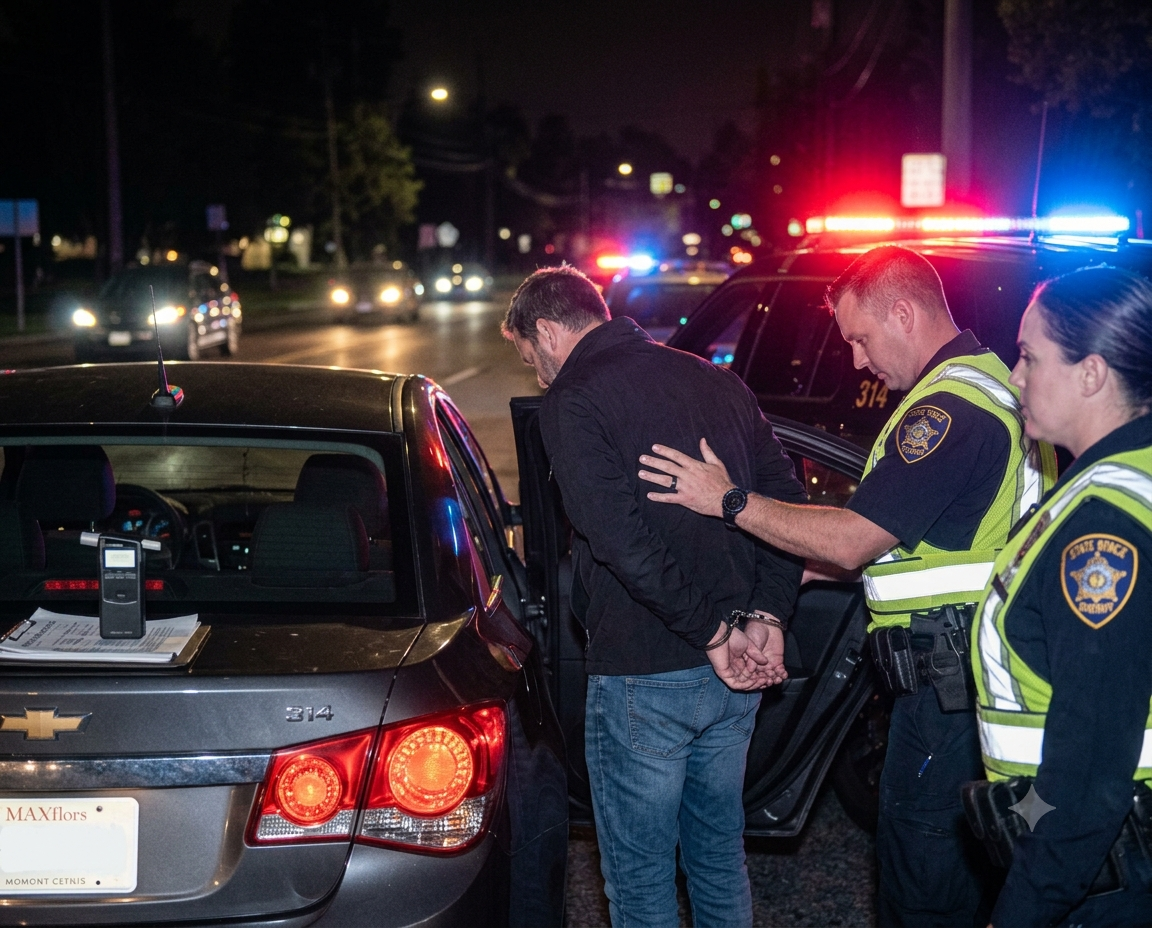
Probable cause is the legal standard used to determine whether police have sufficient grounds to make an arrest under the applicable circumstances.
In a California DUI investigation, police generally consider whether the available facts support a reasonable belief that the driver committed a DUI offense.
The officer does not have to establish the entire criminal case at the roadside. Probable cause for an arrest is a different standard from the proof ultimately required for a criminal conviction.
There is an important difference between the standards used at different stages of a DUI case:
Reasonable suspicion can justify an investigative traffic stop when specific facts indicate a possible traffic violation or criminal activity.
Probable cause concerns whether sufficient grounds exist for an arrest.
Beyond a reasonable doubt is the standard the prosecution must meet to obtain a criminal conviction.
Because these standards are different, police do not need enough evidence to guarantee a conviction before making an arrest.
How Does a DUI Investigation Develop?
A DUI investigation often begins with something the officer observes before or during a traffic stop.
For example, an officer may see a vehicle being driven in an unusual manner. The officer then stops the vehicle and begins investigating the reason for the driving behavior.
During that interaction, the officer may observe additional circumstances.
The investigation may therefore develop in stages:
Initial observation → traffic stop → investigation → additional evidence → probable-cause determination → arrest
The facts available at the beginning of the encounter may not be the same facts available when the officer decides whether to make an arrest.
For example, unusual driving may initially raise suspicion. Later observations, statements, or other evidence may strengthen or weaken the officer’s belief that the driver was impaired.
What Can Police Consider When Determining DUI Probable Cause?
There is no single fact that automatically establishes probable cause in every California DUI investigation.
Instead, police may consider the circumstances as a whole and evaluate the information available at the time of the arrest.
Driving Circumstances
The driver’s conduct behind the wheel may be an important part of the investigation.
Police may consider circumstances such as:
Repeated lane deviations.
Unusual braking or acceleration.
Nearly causing a collision.
Failing to respond appropriately to traffic conditions.
Other conduct suggesting that the driver may not be operating the vehicle normally.
Driving behavior alone does not necessarily establish DUI.
There can be many explanations for unusual driving, including road conditions, distraction, fatigue, or an unexpected event. The significance of the driving behavior depends on the surrounding facts.
What the Officer Observes During the Stop
Once the vehicle is stopped, the officer may observe the driver’s appearance, communication, coordination, and behavior.
For example, an officer may document:
Difficulty responding to questions.
Slurred speech.
Difficulty maintaining balance.
Unusual behavior.
An odor associated with alcohol.
Other circumstances the officer believes may indicate impairment.
These observations can become part of the probable-cause analysis.
However, individual observations are not automatically conclusive. A particular physical symptom may have an explanation unrelated to alcohol or drugs.
Statements Made by the Driver
Information provided by the driver can also become part of the circumstances considered by police.
A driver may acknowledge drinking alcohol, taking medication, or using another substance.
An admission of consumption is not automatically the same thing as an admission of impairment.
For example, saying that alcohol was consumed earlier in the evening does not by itself establish that the driver was under the influence. The officer may consider the statement together with the driver’s driving, appearance, behavior, and other evidence.
Results of DUI-Related Testing
Testing can provide additional information during a DUI investigation.
A preliminary alcohol screening test may give an officer information about the possible presence or concentration of alcohol. Other testing may occur later as part of the evidentiary process.
A chemical test result can be important evidence in a DUI case, but the absence of a completed chemical test does not necessarily prevent an officer from making an arrest.
The officer’s decision may be based on the totality of the circumstances available at the time.
Is a BAC of 0.08% Required for a California DUI Arrest?
No.
The 0.08% BAC threshold is important under California DUI law, but it should not be confused with the separate concept of impairment.
California law prohibits driving with a BAC of 0.08% or more for drivers subject to that statutory limit. California also prohibits driving while under the influence of alcohol.
These provisions address different legal theories.
As a result, a person may potentially be arrested for an impairment-based DUI even when the person’s BAC is below 0.08%.
Example
Consider a driver whose eventual BAC test shows 0.06%.
That number is below 0.08%. It does not automatically establish the BAC-based offense associated with the 0.08% threshold.
However, the result also does not automatically eliminate an allegation that the driver was impaired. Other evidence may be relevant to whether the person was actually under the influence.
The reverse is also important: the mere presence of alcohol in a person’s system does not automatically establish impairment.
Can Police Arrest You Without a Breath Test?
Yes.
California police do not generally have to wait for a completed breath test before making a DUI arrest.
Suppose an officer observes unusual driving and then develops additional reasons to suspect impairment during the traffic stop. The officer may make an arrest based on the circumstances known at that point.
A later breath or blood test may provide additional evidence.
This means the question “Did the police have a breathalyzer result before the arrest?” is not necessarily the same as “Did the police have probable cause to make the arrest?”
Those are separate questions.
Is Suspicion Alone Enough to Arrest Someone for DUI?
No.
A mere hunch or unsupported suspicion is not the same as probable cause.
Police generally need specific facts and circumstances supporting the belief that a DUI offense occurred.
For example, simply seeing a driver leave a restaurant does not establish probable cause for DUI.
Similarly, the fact that someone has consumed alcohol does not automatically establish that the person drove while impaired.
The circumstances become more significant when multiple observations point toward possible impairment.
Example of a Developing Investigation
An officer observes a vehicle moving unusually on the roadway.
After stopping the vehicle, the officer notices additional circumstances that the officer believes are consistent with impairment. The driver also provides information concerning recent alcohol consumption.
The officer can consider all of those facts together rather than treating each fact in isolation.
Whether those circumstances actually establish probable cause depends on the specific facts known to the officer.
What Is the Difference Between Probable Cause and Proof of DUI?
Probable cause should not be confused with the evidence required for a conviction.
Police make an arrest based on the information available during the investigation.
A criminal DUI case, however, must ultimately be proved in court under the applicable legal standard.
This distinction means a person can be arrested even though questions later arise about the strength or admissibility of the evidence.
For example, an arrest may be based partly on an officer’s observations. Later, the defense may examine whether those observations were accurate, whether the investigation was lawful, and whether the prosecution can establish every required element of the offense.
An arrest therefore does not determine the final outcome of a DUI case.
Can the Basis for a DUI Arrest Be Examined Later?
Yes.
The circumstances leading to an arrest can become an issue in subsequent legal proceedings.
A review may consider what happened before the traffic stop, what the officer observed during the encounter, and what information was available when the arrest occurred.
Depending on the circumstances, questions may include:
What caused the initial traffic stop?
What facts did the officer observe?
When did the DUI investigation begin?
What information did the officer obtain?
What facts existed when the arrest was made?
Was the evidence obtained through lawful procedures?
Can the prosecution establish the charged DUI offense?
These questions are highly fact-specific.
The fact that an officer made an arrest does not by itself resolve whether every aspect of the investigation complied with the law.
Can Police Arrest You Before Receiving Chemical-Test Results?
Yes.
The timing of chemical testing is an important point in understanding California DUI arrests.
Police may develop sufficient grounds for an arrest before obtaining an evidentiary breath or blood test. The subsequent test can then become additional evidence in the case.
For example, an officer may conduct a DUI investigation, determine that the circumstances support an arrest, and then proceed with the applicable chemical-testing process after the arrest.
Therefore, a driver should not assume that a DUI arrest was automatically unlawful simply because the chemical-test result was not available beforehand.
Frequently Asked Questions
What do police need to arrest someone for DUI in California?
Police generally need sufficient facts and circumstances to establish probable cause under the applicable law. The evidence can come from multiple sources rather than one mandatory test.
Can police arrest me for DUI if my BAC is unknown?
Yes. A chemical-test result is not necessarily required before an arrest if other circumstances provide sufficient grounds to believe a DUI offense occurred.
Can I be arrested for DUI with a BAC below 0.08%?
Potentially. California separately prohibits driving while under the influence, so a BAC below 0.08% does not automatically rule out an impairment-based DUI allegation.
Is an odor of alcohol enough for a DUI arrest?
An odor of alcohol can be relevant evidence, but it does not automatically establish probable cause by itself. Police may consider it together with the other circumstances.
Does an admission that I drank establish probable cause?
Not necessarily. A statement that someone consumed alcohol does not automatically establish impairment. Its significance depends on the statement’s context and the other evidence available to the officer.
Do police have to complete field sobriety testing before arresting someone?
No single type of field sobriety exercise is necessarily required before every DUI arrest. Police may consider the totality of the circumstances available to them.
Does being arrested mean there is enough evidence to convict?
No. Probable cause for an arrest and proof beyond a reasonable doubt at trial are different legal standards.
Can the legality of a DUI arrest be questioned?
Potentially. The circumstances surrounding the stop, investigation, and arrest can be examined in the legal proceedings that follow. Whether a particular challenge applies depends on the facts and applicable law.
Key Points About California DUI Probable Cause
California DUI probable cause concerns whether police had sufficient grounds to make an arrest based on the circumstances known at the time.
Remember:
Police do not necessarily need a completed breath test before making a DUI arrest.
A BAC of 0.08% is not required for every DUI arrest.
A BAC below 0.08% does not automatically eliminate an impairment-based DUI allegation.
Police can consider multiple facts together.
Driving behavior can lead to a DUI investigation but does not automatically prove impairment.
An admission of drinking does not automatically establish DUI.
An odor of alcohol is relevant but is not necessarily sufficient by itself.
Probable cause is different from proof beyond a reasonable doubt.
A DUI arrest does not automatically mean a person will be convicted.
The circumstances surrounding the stop and arrest can become important in a DUI case.
Contact Southwest Legal
Have Questions About a California DUI Arrest?
Understanding the difference between suspicion, probable cause, and proof can be important when you or a loved one is facing a DUI charge.
An experienced DUI defense attorney at Southwest Legal can review the circumstances of an arrest, explain potential legal issues, and help you understand what to expect next.
Don’t face a California DUI matter without understanding your options. Contact us today for a free consultation and learn more about the legal issues that may apply to your case.
Disclaimer: This article is for general informational purposes only and does not constitute legal advice or create an attorney-client relationship unless and until the firm and client enter into an agreement for legal services. Laws may change, and legal outcomes depend on the specific facts of each case. Consult a qualified attorney for advice regarding your situation.