


California Vehicle Code § 23247(e) makes it unlawful for a person whose driving privilege is restricted under certain California Vehicle Code sections to operate a vehicle that is not equipped with a functioning ignition interlock device (IID).
The current statute specifically applies to people whose driving privilege is restricted. The law is part of California’s broader ignition-interlock framework for certain drivers with alcohol- or DUI-related driving restrictions.
In simple terms, if your California driving privilege requires you to operate a vehicle equipped with a functioning IID, driving a vehicle without the required device can itself be a criminal offense.
A conviction can result in criminal penalties and, depending on the statutory basis for the IID restriction, additional consequences for the driver’s license.
California’s current version of § 23247 became effective January 1, 2026, following legislation extending the IID program. The statute is currently scheduled to remain operative until January 1, 2033, unless the law is changed again.
What Does VC 23247(e) Prohibit?
The central rule is straightforward:
A person subject to one of the specified IID-related driving restrictions may not operate a vehicle that is not equipped with a functioning ignition interlock device.
This means an IID restriction can affect more than the driver’s personal vehicle.
For example, suppose a driver has an IID-restricted license and normally drives a car equipped with an IID. That car breaks down, and the driver borrows a friend’s vehicle that does not have an IID.
The fact that the borrowed vehicle belongs to someone else does not automatically make driving it lawful. Section 23247(e) focuses on the restricted driver’s operation of the vehicle.
California’s DMV similarly explains that drivers with an IID-restricted license generally may drive when the vehicle is equipped with an IID, subject to applicable exceptions and restrictions.
Who Does California Vehicle Code § 23247(e) Apply To?
The statute applies to people whose driving privileges are restricted pursuant to specific California statutes.
Those statutes include:
- Vehicle Code § 13352
- Vehicle Code § 13352.1
- Vehicle Code § 13353.6
- Vehicle Code § 13353.75
- Vehicle Code § 23575
- Vehicle Code § 23575.3
- Vehicle Code § 23700
The specific statute underlying a person’s restriction matters because different laws can impose different restrictions and different consequences following an IID violation.
For that reason, it is not always accurate to say that every person accused of violating § 23247(e) simply has a “DUI restricted license.” The legal basis for the restriction should be examined in the individual case.
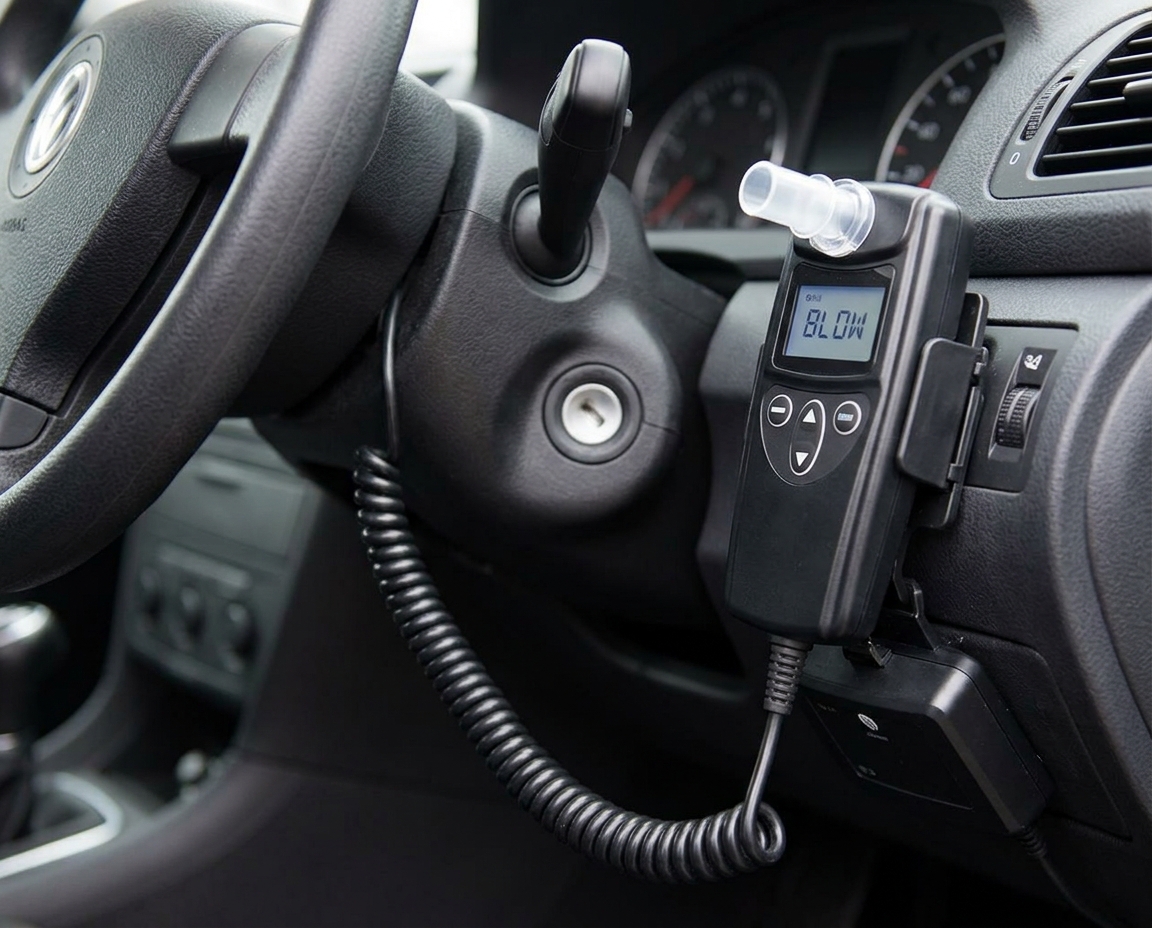
What Is an Ignition Interlock Device?
An ignition interlock device is an alcohol-detection device connected to a vehicle’s ignition system.
The driver generally must provide a breath sample before starting the vehicle. If the device detects alcohol above its programmed threshold, the vehicle may not start.
California DMV explains that an IID can also require additional breath samples while the vehicle is being driven. Under the statewide IID program, the device must be calibrated and inspected by a certified installer at intervals not exceeding 60 days.
California also maintains requirements for approved IID manufacturers and certified installers.
An IID is therefore more than a piece of equipment installed in a vehicle. When required as part of a driver’s license restriction, it becomes part of the driver’s legal authorization to operate a vehicle.
Is VC 23247(e) a Misdemeanor?
A violation of Vehicle Code § 23247 is punishable under subdivision (f).
The statute provides for:
- Up to six months in county jail;
- A fine of up to $5,000;
- Or both imprisonment and the fine.
These are statutory maximum penalties. They do not mean every person convicted of § 23247(e) will automatically receive six months in jail or a $5,000 fine.
The actual consequences in an individual case depend on the applicable law and circumstances.
California court materials also identify § 23247(e) as an offense involving operation of a vehicle without the required IID and list the statutory maximum punishment under § 23247(f).
Can Driving Without an IID Result in a License Suspension?
Yes.
In addition to the criminal penalties in subdivision (f), California Vehicle Code § 23247(g) establishes specific DMV consequences after a conviction under subdivision (e).
The consequence depends on the statutory basis for the driver’s IID restriction.
Restrictions under §§ 13352, 13352.1, 13353.6, or 13353.75
Under § 23247(g)(1), if a person whose driving privilege is restricted under one of these sections is convicted of violating § 23247(e), the court must notify the DMV.
The DMV must then immediately terminate the IID restriction and suspend or revoke the person’s driving privilege for the remaining period of the originating suspension or revocation and until applicable reinstatement requirements are satisfied.
Restrictions under § 23575.3, § 23575(a) or (i), or § 23700
Under § 23247(g)(2), a person in these categories who is convicted of violating subdivision (e) is subject to a one-year suspension of the driving privilege beginning on the date of conviction.
This distinction is important because the DMV consequences are not identical for every driver subject to an IID restriction.
Can You Drive Someone Else’s Car Without an IID?
Generally, you should not assume that you can.
If your driving privilege is subject to an IID restriction covered by § 23247(e), driving a vehicle without a functioning IID can create a violation even if the vehicle is owned by someone else.
Example
Maria has an IID-restricted driver’s license. Her vehicle is being repaired.
Her sister offers to let Maria use her car for two days. The sister’s car does not have an IID.
Maria may think the restriction applies only to the vehicle she normally drives. However, § 23247(e) addresses the operation of any vehicle by a person whose privilege is restricted under the listed statutes.
That means borrowing another person’s vehicle is not automatically an exception.
Can You Rent a Car With an IID-Restricted License?
This is an area where particular caution is warranted.
California Vehicle Code § 23247(a) makes it unlawful to knowingly rent, lease, or lend a motor vehicle to a person known to have an applicable IID-related driving restriction unless the vehicle is equipped with a functioning, certified IID.
The restricted driver also has a statutory obligation to notify the person renting, leasing, or lending the vehicle about the driving restriction.
The California DMV’s current IID program information likewise states that renting a car during an IID restriction presents legal restrictions under California law.
Therefore, an IID-restricted driver should not assume that an ordinary rental vehicle can legally be used simply because the rental company approves the rental.
What About Borrowing a Family Member’s Car?
The same basic issue applies to family vehicles.
Being a spouse, parent, sibling, or other relative does not automatically create an exception to an IID restriction.
For example, if an IID-restricted driver borrows a parent’s vehicle to go to work and the vehicle does not have a functioning IID, the driver could potentially face a § 23247(e) violation.
The important question is not simply who owns the vehicle. It is whether the driver’s legal restriction permits the driver to operate that particular vehicle.
What If the IID Stops Working?
A malfunctioning IID can create a difficult situation, but a malfunction should not simply be ignored.
California’s IID program requires periodic calibration and inspection. DMV states that an IID must be serviced by a certified installer at intervals not exceeding 60 days.
DMV also explains that if an installer reports that a driver failed to comply with the required calibration schedule, DMV can suspend or revoke the driving privilege. If the driver’s privilege is suspended for IID noncompliance, the driver may need to return to the installer, become compliant, and have the installer submit the appropriate verification to DMV.
What should you do if your IID malfunctions?
A driver dealing with an IID problem should generally:
- Contact the certified IID installer promptly.
- Follow the installer’s instructions.
- Keep records of the malfunction and communications.
- Attend required service or calibration appointments.
- Avoid assuming that a malfunction gives permission to drive an unrelated vehicle without an IID.
- Review any DMV notices carefully.
The circumstances surrounding a malfunction can matter, particularly if a criminal allegation or DMV action follows.
Is IID Tampering the Same as a VC 23247(e) Violation?
No.
California Vehicle Code § 23247 contains several separate prohibitions.
Subdivision (b)
Subdivision (b) prohibits a person with an applicable restricted driving privilege from requesting or soliciting another person to blow into an IID or start an IID-equipped vehicle for the purpose of providing the restricted person with an operable vehicle.
Subdivision (c)
Subdivision (c) prohibits another person from blowing into an IID or starting an IID-equipped vehicle for the purpose of providing an operable vehicle to the restricted driver.
Subdivision (d)
Subdivision (d) prohibits removing, bypassing, or tampering with an IID.
Subdivision (e)
Subdivision (e) addresses the restricted driver operating a vehicle that is not equipped with a functioning IID.
These are separate provisions even though the underlying circumstances can sometimes overlap.
What If Someone Else Blows Into the IID?
California law specifically addresses this conduct.
For example, suppose a driver has an IID restriction but asks a friend to provide the breath sample needed to start the vehicle.
That situation can implicate subdivision (b), while the friend’s conduct can implicate subdivision (c).
The law is designed to prevent a restricted driver from circumventing the IID requirement by having another person operate or activate the device on the driver’s behalf.
Does an IID Restriction Mean You Can Drive Anywhere?
An IID-restricted driver license generally allows a qualifying driver to operate a vehicle equipped with an IID, subject to the specific restriction and applicable law.
California DMV states that participants in the statewide IID program who install an IID may drive “anytime or anywhere” as long as the vehicle is equipped with an IID, subject to the program’s rules and exceptions.
However, an IID-restricted license does not mean a person can drive without a valid license or ignore other restrictions.
The driver must still comply with the terms of the applicable license and IID program.
Is There an Exception for an Employer’s Vehicle?
Yes, California provides an employer-vehicle exception in certain circumstances.
California DMV explains that a person who has been issued an IID-restricted driver’s license may drive an employer’s vehicle during the scope of employment without an IID if the applicable requirements are satisfied.
The driver must complete the required Notice to Employers Ignition Interlock Restriction (DL 923) form and provide it to the employer. The driver must also keep a copy with them or with the employer’s vehicle.
There is an important limitation: DMV states that a person who has received an exemption from mandatory IID installation does not qualify for the employer-vehicle exemption.
This is one reason it is important not to treat every vehicle without an IID as automatically prohibited. Some statutory or program-specific exceptions can apply.
How Long Do California IID Restrictions Last?
There is no single IID period that applies to every driver.
Under California’s current statewide IID program, repeat DUI offenders and first-time DUI offenders whose violations involved injury can be subject to mandatory IID periods ranging from one to four years, depending on prior DUI convictions and other circumstances.
DMV currently lists these mandatory periods for qualifying alcohol-related offenses:
| Prior DUI convictions within 10 years | Non-injury offense | Injury offense |
|---|---|---|
| 0 | No mandatory IID period | 1 year |
| 1 | 1 year | 2 years |
| 2 | 2 years | 3 years |
| 3 or more | 3 years | 3 years |
| 1 or more prior felony convictions | 3 years | 4 years |
These periods apply within the statewide IID program to the qualifying offenses and circumstances identified by DMV.
The statewide IID pilot program now runs through December 31, 2032, following legislation extending the program to January 1, 2033.
Does Every DUI Require an IID in California?
No.
The IID rules depend on the type of DUI, whether the offense involved alcohol, whether there was an injury, prior DUI convictions, and other circumstances.
For example, under the statewide IID program, qualifying repeat and injury-involved DUI offenders are subject to mandatory IID requirements. A first-time, non-injury alcohol-related DUI is treated differently and may involve a court-ordered IID or an optional IID-restricted license.
DMV also identifies certain exclusions and alternative restrictions, including specific treatment of drug-only offenses and certain administrative suspensions.
Therefore, it is not accurate to state that every California DUI automatically requires an IID.
What Happens if You Never Install a Required IID?
If a driver is subject to a mandatory IID installation requirement and does not comply, the driver may not receive the IID-restricted driving privilege.
California DMV explains that a person who never complies with a mandatory IID installation requirement will not be issued a driver’s license under that program and cannot legally drive.
This is different from the situation addressed by § 23247(e), which concerns a person whose driving privilege is already restricted under one of the specified statutes and who then operates a vehicle without the required functioning IID.
What Happens After an IID Violation?
The consequences can involve both the criminal court and the DMV.
A typical case may involve:
- An alleged violation of the IID restriction.
- A citation, arrest, or criminal filing.
- A criminal court proceeding.
- Possible conviction under § 23247(e).
- Notification to the DMV following a conviction.
- License suspension, revocation, or termination of the IID restriction depending on the applicable statutory category.
- Additional requirements before the driving privilege can be reinstated.
The criminal case and DMV consequences are related but are not necessarily the same proceeding.
Frequently Asked Questions
Vehicle Code § 23247(e) prohibits a person whose driving privilege is restricted under specified California statutes from operating a vehicle that is not equipped with a functioning ignition interlock device.
Is VC 23247(e) a misdemeanor?
A violation of § 23247 is punishable under subdivision (f) by up to six months in county jail, a fine of up to $5,000, or both. California court materials classify § 23247(e) as an offense carrying that statutory maximum.
What is the maximum fine for a VC 23247(e) violation?
The statutory maximum fine is $5,000 under Vehicle Code § 23247(f). The maximum statutory penalty does not mean that every conviction results in that fine.
Can I drive my friend’s car without an IID?
If your driving privilege is restricted under one of the statutes identified in § 23247(e), you generally cannot assume that you may drive a friend’s vehicle without an IID. The restriction applies to operating a vehicle, not simply to owning a particular car.
Can I drive a rental car with an IID restriction?
California law places restrictions on renting, leasing, or lending vehicles to people with applicable IID restrictions. An ordinary rental vehicle without the required IID should not be assumed to be lawful to operate.
Can I drive my employer’s vehicle without an IID?
Potentially, yes. California DMV provides an employer-vehicle exception for qualifying IID-restricted drivers who satisfy the required documentation and conditions. The DL 923 Notice to Employers form is part of that process.
What if my IID is broken?
Contact the certified IID installer promptly and document the problem. California has specific IID maintenance and compliance requirements, including periodic calibration. Do not assume that an IID malfunction automatically allows you to drive another vehicle without an IID.
What happens if I miss my IID calibration appointment?
DMV states that the installer can report noncompliance if the IID is not calibrated within the required 60-day period, and DMV can suspend or revoke the driving privilege.
Can someone else blow into my IID?
California Vehicle Code § 23247 specifically prohibits requesting or soliciting another person to blow into an IID or start an IID-equipped vehicle for the purpose of providing the restricted driver with an operable vehicle. Separate provisions address the other person’s conduct.
Does an IID violation automatically result in a one-year suspension?
Not necessarily. The applicable DMV consequence depends on the statutory basis for the IID restriction. Section 23247(g) provides different consequences for different categories of restricted drivers.
Can an IID violation lead to jail?
Yes. Vehicle Code § 23247(f) authorizes imprisonment in county jail for up to six months upon conviction, as well as a possible fine of up to $5,000.
What Should You Do If You Are Accused of Violating VC 23247(e)?
An IID-related allegation can have both criminal and driver’s-license consequences. If you receive a citation, criminal charge, or DMV notice, it is important to understand exactly what restriction applies to your driving privilege.
Consider gathering and preserving:
- Your current driver’s license and restriction information
- DMV suspension or restriction notices
- Court documents
- The IID installation documentation
- IID calibration and service records
- Notices from the IID installer
- Repair or malfunction records
- Any citation or criminal paperwork
Pay attention to deadlines stated in court or DMV documents.
Because the legal consequences can depend on the statutory basis for the restriction and the facts surrounding the alleged violation, a California attorney can review the applicable documents and explain the legal issues that may affect your situation.
Key Takeaways
California Vehicle Code § 23247(e) is an important IID-related driving restriction law.
The key points are:
- VC 23247(e) prohibits certain IID-restricted drivers from operating vehicles without a functioning IID.
- The statute specifically identifies the California Vehicle Code sections under which the driving privilege must be restricted.
- The rule can apply when the vehicle belongs to someone else.
- Renting, leasing, or lending a vehicle to an applicable IID-restricted driver is separately regulated by § 23247(a).
- Asking another person to provide an IID breath sample can violate § 23247(b).
- Providing the breath sample or starting the vehicle for the restricted driver can violate § 23247(c).
- Removing, bypassing, or tampering with an IID is prohibited by § 23247(d).
- A conviction under § 23247 can carry up to six months in county jail, a fine of up to $5,000, or both.
- Additional DMV consequences can follow a conviction under § 23247(e).
- The DMV consequence depends on the statutory basis for the driver’s IID restriction.
- Certain exceptions, including an employer-vehicle exception, can apply under specific circumstances.
- IID maintenance and calibration requirements are important to continued compliance.
- California’s statewide IID program has been extended through December 31, 2032.
California’s IID laws have changed over time, and the current version of Vehicle Code § 23247 became effective January 1, 2026. Because the law can change and the consequences can depend on the specific restriction involved, current California statutes and DMV information should be reviewed when evaluating an individual matter.
Contact Southwest Legal
Need Help Understanding an IID Violation?
A charge or allegation involving California Vehicle Code § 23247(e) can raise important questions about your criminal exposure, driver’s license, IID requirements, and potential DMV consequences.
If you are dealing with an IID-related violation, Southwest Legal encourages you to gather your citation, DMV notices, court documents, and IID records and seek guidance about the laws and procedures that may apply to your circumstances.
Contact us today for a free consultation.
Disclaimer: This article is for general informational purposes only and does not constitute legal advice or create an attorney-client relationship. No attorney-client relationship is formed unless and until the firm and client enter into an agreement for legal services. Laws may change, and legal outcomes depend on the specific facts of each case. Consult a qualified attorney for advice regarding your situation.