


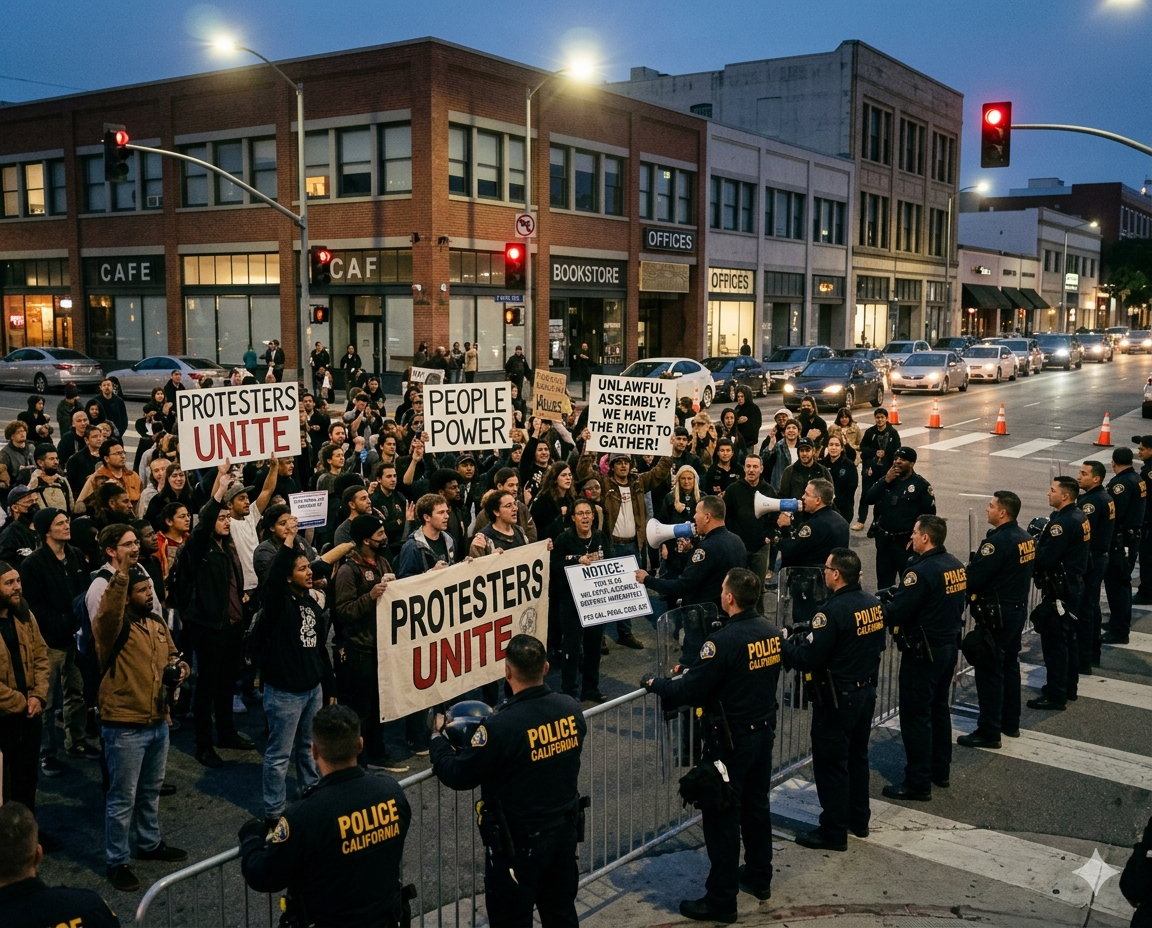
California Penal Code Sections 407 and 408 address the crime of unlawful assembly. These laws are commonly enforced during riots, protests, demonstrations, public disturbances, and large gatherings where violence or illegal conduct may occur. While many people associate unlawful assembly with riots, the law can apply in a variety of situations involving groups of people acting unlawfully or violently.
Understanding these laws is important because unlawful assembly charges can affect protesters, event participants, organizers, and even bystanders in some cases. At the same time, California law must respect constitutional protections such as freedom of speech and the right to peaceful assembly under the First Amendment.
This guide explains what unlawful assembly means under California law, the penalties involved, legal defenses, and the difference between peaceful protest activity and criminal conduct.
What Is California Penal Code § 407?
California Penal Code § 407 defines unlawful assembly as a situation where two or more people gather together to:
- Commit an unlawful act, or
- Perform a lawful act in a violent, boisterous, or tumultuous manner
In simple terms, a gathering does not become illegal merely because people assemble together. The issue is whether the group intends to engage in unlawful conduct or whether the gathering creates violence or an immediate threat to public safety.
Examples of situations that may lead to unlawful assembly allegations include:
- Crowds gathering to vandalize property
- Demonstrations that escalate into violent confrontations
- Groups blocking emergency responders or public roadways unlawfully
- Participants engaging in assaults, looting, or property destruction during protests
California courts have also recognized that peaceful protests and protected speech cannot automatically be labeled unlawful assemblies simply because they are loud, emotional, or controversial. Generally, there must be actual violence or a clear threat of imminent violence.
What Is California Penal Code § 408?
Penal Code § 408 makes participation in an unlawful assembly a criminal offense.
Under the law, any person who knowingly participates in an unlawful assembly or rout may be charged with a misdemeanor.
Importantly, prosecutors do not always need to prove that a person personally committed violence. Participation itself may be enough if the individual knowingly took part in the unlawful gathering.
Elements Prosecutors Must Prove
To convict someone under Penal Code 408, prosecutors generally must establish the following:
- The defendant intentionally participated in the assembly
- The assembly qualified as unlawful under California law
- The defendant knew the gathering involved unlawful conduct or violent activity
Intent and knowledge are important factors in these cases. Someone who unknowingly walks into a chaotic area or remains briefly without understanding what is happening may have valid legal defenses.
Peaceful Protest vs. Unlawful Assembly
One of the most misunderstood aspects of California unlawful assembly law is the belief that any protest can automatically be declared illegal.
The United States Constitution protects:
- Freedom of speech
- Peaceful assembly
- Political demonstrations
- Public protests
- Freedom of association
Because of these constitutional protections, California courts carefully examine unlawful assembly cases. A peaceful protest generally remains lawful even if it is noisy, disruptive, or unpopular.
However, a lawful gathering can become unlawful if:
- Violence breaks out
- Participants destroy property
- Individuals assault others
- There is an immediate threat of violence
- Public safety is seriously endangered
This distinction is especially important during large-scale demonstrations where only a small percentage of participants may engage in criminal behavior.
Common Situations Leading to Unlawful Assembly Charges
Unlawful assembly charges often arise in several types of situations.
Political Demonstrations
Large protests can sometimes escalate into confrontations involving property damage or physical violence. In those situations, law enforcement may declare the gathering an unlawful assembly.
Riots and Looting Incidents
During riots, people accused of participating in destructive or violent behavior may face unlawful assembly charges in addition to other criminal offenses.
Street Takeovers and Illegal Gatherings
Street racing events, sideshows, or large unauthorized gatherings that block traffic or create dangerous conditions may result in unlawful assembly allegations.
Sporting Event Disturbances
Crowds celebrating major sporting victories occasionally become destructive, leading to arrests related to unlawful assembly or rioting.
Campus Protests
University demonstrations involving vandalism, trespassing, or violent confrontations may also lead to criminal charges.
What Happens When Police Declare an Unlawful Assembly?
When authorities determine that a gathering has become dangerous or unlawful, police may formally declare an unlawful assembly and issue dispersal orders.
These orders usually instruct people to:
- Leave the area immediately
- Stop participating in the gathering
- Avoid obstructing streets or emergency personnel
Police commonly use loudspeakers, sirens, or public announcements to warn crowds before making arrests.
Failure to comply with lawful dispersal orders can lead to additional criminal charges, including failure to disperse under California law.
However, law enforcement actions during protests remain subject to constitutional limitations. Improper dispersal orders or excessive police conduct may become important legal issues in court.
Penalties for Penal Code § 408
A violation of California Penal Code 408 is generally charged as a misdemeanor offense.
Potential penalties may include:
- Up to six months in county jail
- Fines of up to $1,000
- Informal probation
- Community service
- Court-ordered counseling or classes
Although unlawful assembly itself is usually a misdemeanor, related criminal conduct may lead to more serious charges and harsher penalties.
For example, prosecutors may also file charges involving:
- Vandalism
- Assault or battery
- Trespassing
- Resisting arrest
- Arson
- Looting
- Riot participation
The overall consequences can become much more severe depending on the circumstances of the incident.
Related California Offenses
Several California crimes are closely connected to unlawful assembly laws.
A riot generally involves two or more people using force or violence together. Riot charges are frequently filed alongside unlawful assembly allegations.
Penal Code 409 – Failure to Disperse
This law makes it illegal to remain at the scene of a riot or unlawful assembly after law enforcement issues a lawful order to leave.
Penal Code 415 – Disturbing the Peace
Disturbing the peace charges may apply when individuals engage in fighting, unreasonable noise, or behavior likely to provoke violence.
Demonstrators who remain on private property after being asked to leave may also face trespassing charges.
Legal Defenses to Unlawful Assembly Charges
Being arrested for unlawful assembly does not automatically result in a conviction. Several legal defenses may apply depending on the facts of the case.
Lack of Knowledge
Prosecutors must prove the defendant knew the gathering involved unlawful activity or violence.
No Intentional Participation
A person accidentally caught in a crowd or attempting to leave the area may argue they did not willingly participate.
Constitutional Protection
Peaceful protest activity is protected under the First Amendment. If the defendant did not engage in violence or illegal conduct, constitutional defenses may apply.
Mistaken Identity
Large demonstrations often create confusion, making mistaken arrests possible due to poor visibility, masks, crowd movement, or chaotic conditions.
Unlawful Police Conduct
Defense attorneys may challenge arrests involving unconstitutional dispersal orders, excessive force, or violations of civil rights.
Long-Term Consequences of a Conviction
Even though unlawful assembly is generally a misdemeanor, a conviction can still create lasting consequences.
A criminal record may affect:
- Employment opportunities
- Professional licenses
- College admissions
- Immigration status
- Housing applications
- Background checks
In some situations, individuals may qualify for expungement after successfully completing probation or sentencing requirements.
Constitutional Concerns and Civil Rights
Unlawful assembly laws often raise important constitutional questions because they involve balancing public safety with civil liberties.
Courts carefully examine whether:
- Actual violence occurred
- Police issued lawful warnings
- Defendants personally engaged in unlawful conduct
- Authorities violated free speech protections
These safeguards help ensure that peaceful political expression and lawful demonstrations remain protected under the Constitution.
Frequently Asked Questions
Is unlawful assembly the same as rioting?
No. Unlawful assembly generally involves participation in a gathering connected to unlawful or violent conduct, while rioting usually involves actual use of force or violence.
Can peaceful protesters be arrested?
Peaceful protesters are generally protected by the First Amendment. However, arrests may still occur during chaotic situations if police believe the gathering has become unlawful.
Do police have to warn crowds before arrests?
In many situations, law enforcement provides dispersal warnings before making arrests. Whether those warnings were lawful may become an important issue in court.
Can bystanders be charged?
Potentially, yes. However, prosecutors must still prove the individual knowingly and intentionally participated in the unlawful assembly.
Is unlawful assembly a felony?
Typically, no. Under Penal Code 408, unlawful assembly is generally charged as a misdemeanor offense.
Final Thoughts
California Penal Code 407 and 408 are designed to address gatherings that involve violence, unlawful conduct, or threats to public safety. At the same time, the law must respect constitutional rights protecting peaceful protests and free speech.
The difference between lawful protest activity and unlawful assembly often depends on the specific facts of each case, including whether violence occurred, whether participants knowingly engaged in illegal conduct, and whether law enforcement acted within constitutional limits.
Anyone facing unlawful assembly allegations should understand that even misdemeanor charges can carry serious consequences affecting employment, education, housing, and future opportunities.
Contact Southwest Legal
If you or a loved one has been arrested or charged under California Penal Code 407 or 408, it is important to speak with an experienced criminal defense attorney as soon as possible. Early legal representation can help protect your rights, evaluate possible defenses, and work toward the best possible outcome in your case.
The legal team at Southwest Legal understands the complexities of unlawful assembly, protest-related offenses, and constitutional defense cases. Whether you are facing misdemeanor charges or more serious allegations connected to a public gathering, experienced legal guidance can make a significant difference.
Contact us today for a free consultation and learn more about your legal options.
Disclaimer: This article is for general informational purposes only and does not constitute legal advice or create an attorney-client relationship. No attorney-client relationship is formed unless and until the firm and client enter into an agreement for legal services. Laws may change, and legal outcomes depend on the specific facts of each case. Consult a qualified attorney for advice regarding your situation.